Making of- photoshootings
- Oct 4, 2025
- 3 min read
Updated: Oct 12, 2025
This part of the project was definitely the most interesting one. Even though my magazine focuses on politics and media, I still wanted to explore what a photoshoot could bring to the overall design. The process helped me understand how visuals can influence the tone and message of an article — and also how much work goes on behind the scenes, even for just a few photos.
Preparation
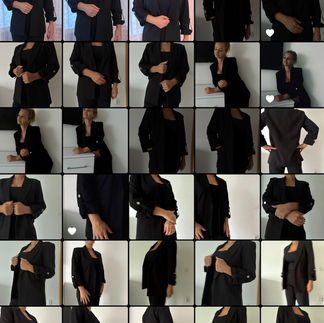
Before the shoot, I made a list of what I needed: my camera, tripod, a few light sources, and of course, the outfit. I went for a black suit, as it’s a classic symbol of professionalism and seriousness — all values that fit perfectly within a political-themed magazine. I didn’t rent a studio or use professional equipment; instead, I improvised in my living room, which I turned into a mini setup. It wasn’t perfect, but it allowed me to play around with light and composition in a space I could control easily.
I wanted everything to feel simple yet deliberate. The background was kept minimal, and I focused on contrast — light on dark — to emphasize the subject and create a slightly dramatic atmosphere.
Working with the Model
For the model, I chose a family member, mainly because she fit the look I wanted, and it was easier to communicate ideas without feeling pressured; this for me seemed like the best idea since I was new to the domain. Since my magazine already has a somewhat feminine identity, I thought using a woman would help emphasize that side while keeping it professional and mature.
We talked before starting about what the expressions should convey — confidence, focus, and a bit of introspection. I painted her nails red to symbolize determination and strength, and styled her hair in a way that kept her face clear and sharp. I didn’t want anything too glamorous or editorial — more realistic, something that could actually appear in a cultural publication.
Challenges and On-the-Spot Ideas
There were definitely some challenges. Setting up lighting without professional gear took a while, and I had to adjust the angles constantly. I also realized that even small movements or expressions changed the tone completely, so I started experimenting — taking some photos from a lower angle, higher angle as well as straight-on to keep a sense of directness.
At one point, I noticed that softer lighting worked better than harsh shadows for this concept, so I adapted. These small discoveries really shaped the final results.
Behind the Lens
I worked entirely alone, without any help, which was a bit stressful at first. Balancing between camera settings, posing, and lighting adjustments was a learning experience. But honestly, that made the process more rewarding — every picture was 100% my own effort.
What Changed Later
Originally, I planned to use more portraits from this shoot, but as I started designing the pages, I realized they didn’t fit perfectly with the serious theme. Instead, I decided to combine just a few of these images with documentary-style photos I took in Washington and New York. The portraits brought a human touch, while the city photos grounded the magazine in real-world political context. Together, they balanced each other out really well.
Reflection
Looking back, I’m happy I did this. It taught me a lot about visual composition, lighting, and the mood that a single image can communicate. If I were to do it again, I’d probably plan the setup better and have someone assist me — maybe just to handle the lights. But I’d keep the same concept and simplicity. Working with family made the experience so much better and exciting, giving me to work freely without restrains.
Here are some of the original, raw pictures which I have also uploaded on my explicit Photoshoot post in the Research and Planning Task:




Comments